

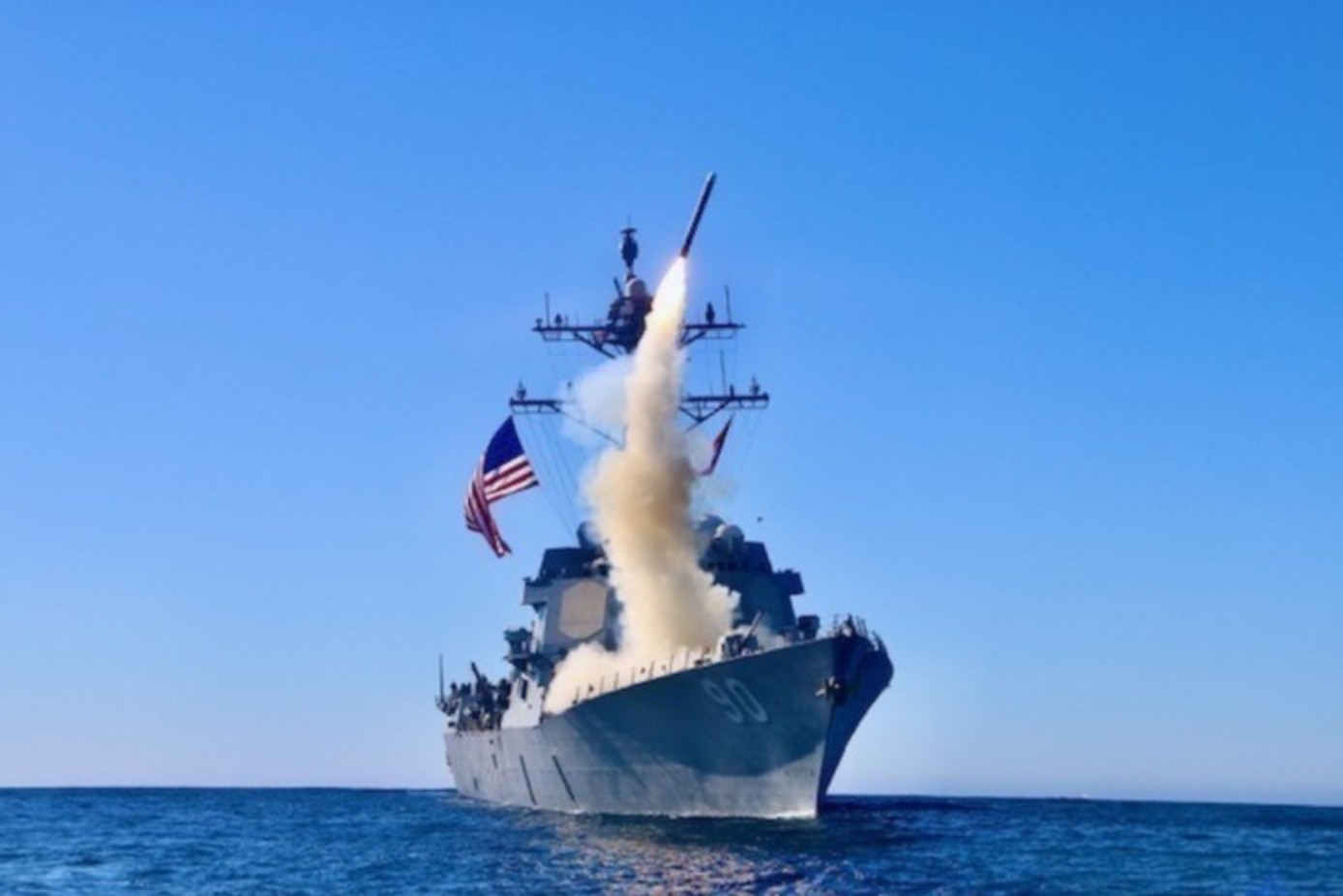
Raytheon Co., one of the world’s largest defense contractors, has announced that the guided-missile destroyer USS Chafee (DDG 90) launches a newest cruise missile variant, the Tomahawk Block V, during a missile exercise.
According to a company news release, the U.S. Navy and Raytheon Missiles & Defense, a Raytheon Technologies business, successfully completed two flight tests with the Tomahawk Block V.
U.S. Navy officials said that this event marked the first time a Block V Tomahawk missile was operationally tested, marking the Navy’s transition to a more advanced capability for the fleet. Block V includes an upgrade that will enhance navigation performance and provide robust and reliable communications.
Tomahawk is a highly accurate, GPS-enabled missile that can fly into heavily defended airspace and conduct precise strikes on high-value targets with minimal collateral damage. The advanced Tomahawk Block V includes improved navigation and communications.
“These tests keep the Navy on schedule to introduce Block V into the fleet next year,” said Kim Ernzen, vice president of Naval Power at Raytheon Missiles & Defense. “Our modernization and recertification efforts will also extend the missile’s service life by 15 years.”
During the tests, the missiles were redirected mid-flight to different targets using their new advanced communications architecture systems.
“The Block V capabilities reinforce Tomahawk’s unequivocal role as the Navy’s long-range strike weapon far into the future,” said Capt. John Red, the Navy’s Tomahawk Weapons System program manager. “These tests are tremendous milestones for our teams that have been working on these improvements for several years.”
Additional Block V enhancements, such as a maritime strike capability (Block Va) and a programmable warhead for an expanded land attack capability (Block Vb), are in development for future deliveries. Block Va will strike moving targets at sea, while Block Vb will defeat a more diverse range of land targets.