

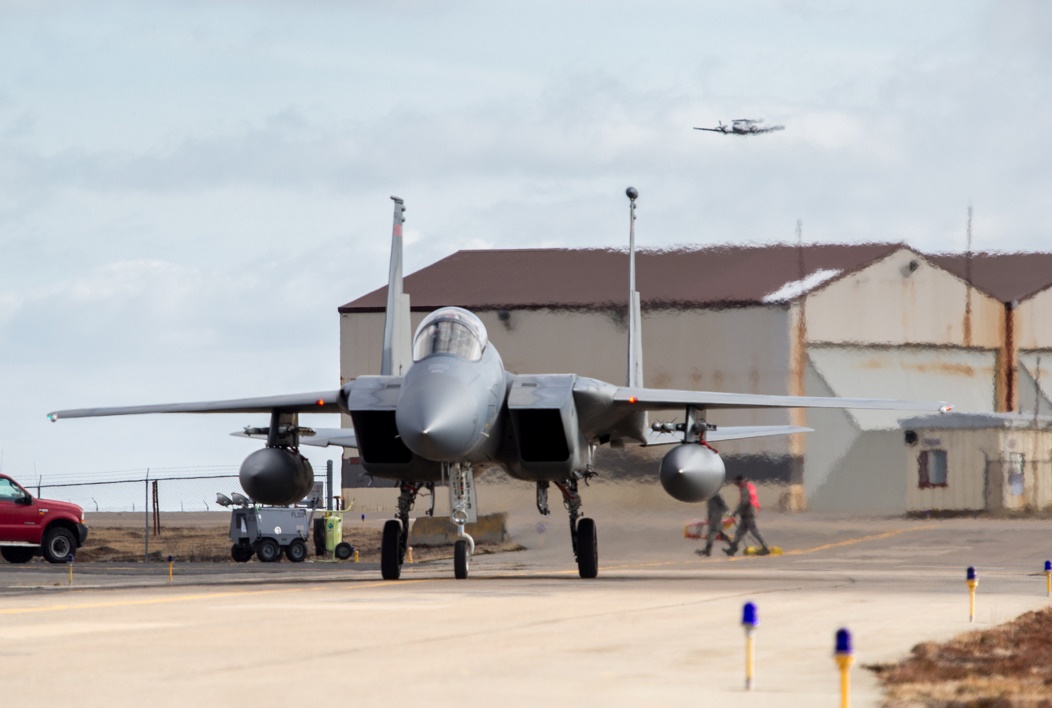
Since 3 April, four F-15C fighter aircraft from 104thFighter Wing – an Air National Guard unit – and KC-135 tanker aircraft from the Air Force Reserve Command as well as 160 airmen from the continental United States have been deployed to Iceland to assist the country’s Coast Guard with air interception capabilities.
Following four days of practice flights to familiarize with the local and regional airspace NATO’s Combined Air Operation Centre (CAOC) at Uedem in northwest Germany declared the F-15Cs fully operationally capable. The pilots and crews demonstrated their proficiency at Allied tactics, techniques and procedures and have been ready since 7 April to be launched by the CAOC under the control of the local Control and Reporting Centre (CRC) at Keflavik at a moment’s notice under NATO Air Policing arrangements.
Allies, in conjunction with the Icelandic authorities, have agreed to maintain a periodic presence of NATO fighter aircraft based at Keflavik to help keep Icelandic airspace safe and secure. US F-15Cs provide the first of three such deployments in 2016.
“The F-15C Eagle fighter jets are capable aircraft built for air-to-air operations,” says Lieutenant Colonel Jeff “Monty” Beckel, the detachment commander of the fUS F-15Cs at Keflavik. “They pick up any threats that are long range as the aircraft integrate a radar that works well against all threats. The extra fuel tanks and an air-to-air refuelling capability extend the range of the jets while flying missions here.” The jets are scrambled for training flights and real-world mission as required; US fighter controllers in the CRC at Keflavik have mission control during these sorties.
“As the 104th Fighter Wing we are a Massachusetts Air National Guard unit and we have KC-135 tanker support from the Air Force Reserve and we have support from Spangdahlem Air Force Base in Germany, which is an active duty component,” says LtCol Beckel. “We have a wide variety of personnel and assets – what we call Total Force Integration – working for the NATO Air Policing. Back home our mission is also an alert mission and we accomplish that from our home base and deployed anywhere around the world.”
Out of the approximately 1,000 members in the 104th Fighter Wing only 250 are full time members. “A lot of members have civilian jobs on the side,” says LtCol Beckel. “I fly civilian airliners as a pilot full-time and then I am a part time pilot in the ANG. It requires quite a bit of support from the employers especially when we deploy abroad for many months. But it means a great deal to me to be able to serve my country with the Air National Guard as part of the Air Force.”
These deployments are a visible expression of NATO’s commitment to Iceland’s security and an expression of shared responsibilities and values.
The “peacetime preparedness” mission usually involves a deployment (typically of around three-four weeks, three times a year) of fighter aircraft from Allied nations. These aircraft familiarise with the airspace and are certified by Combined Air Operations Centre (CAOC) Uedem to execute the NATO mission in Icelandic airspace to ensure the Alliance can conduct full-scale peacetime air policing activities at the shortest possible notice if required by real world events.
“The Icelandic Coast Guard have been great with their support and their facilities during our stay,” concludes LtCol Beckel. “They provide the Search and Rescue mission with their helicopters in this harsh environment and they will pick us up should we have to eject from our jets in an emergency.”