

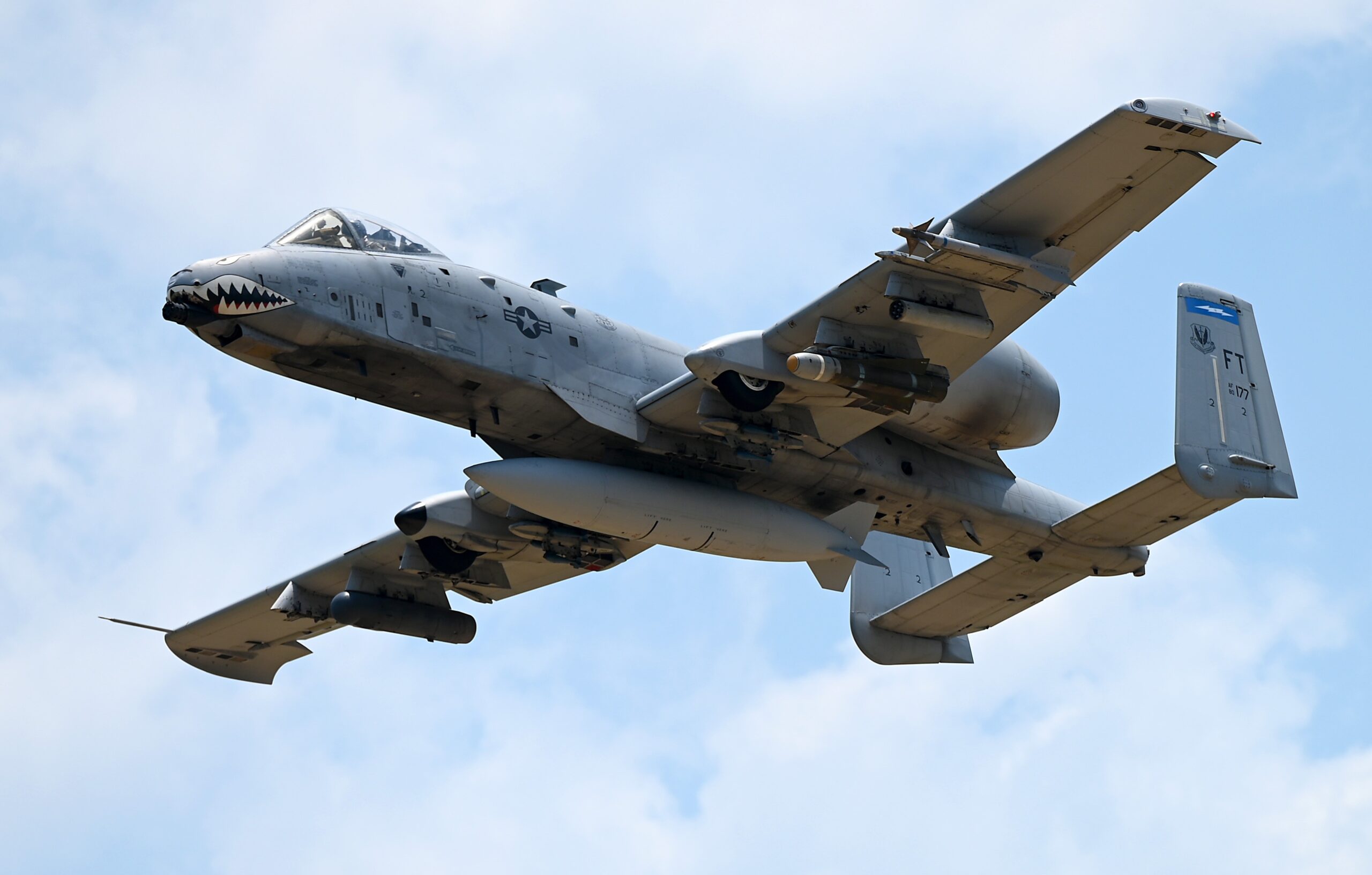
The U.S. Air Force plans to retire all remaining A-10 Thunderbolt II aircraft—commonly known as the “Warthog”—in fiscal year 2026, according to the service’s newly released budget documents.
The move is part of a broader plan to divest 340 aircraft across multiple platforms, Defense News reported last week.
The proposal, if approved by Congress, would represent the largest single-year aircraft retirement effort by the Air Force in years. The final 162 A-10s would be phased out ahead of the service’s original timeline, which had projected full retirement closer to 2030.
The retirement plan was disclosed as part of the Department of the Air Force’s $211 billion discretionary budget request for fiscal 2026. Of that amount, $184.9 billion is allocated to the U.S. Air Force and $26.1 billion to the U.S. Space Force. The department is also seeking an additional $38.6 billion through a budget reconciliation package, which includes $24.7 billion for the Air Force and $13.8 billion for the Space Force.
If the reconciliation bill passes, the Department of the Air Force would receive a total of $249.5 billion in funding—an increase of 17.2% compared to fiscal 2025. However, if it does not pass and the original request remains unchanged, the Space Force would face an 8.7% budget cut, while Air Force funding would remain nearly flat.
The Air Force said earlier this year that, in line with a directive from Secretary of Defense Pete Hegseth to reallocate 8% of overall defense spending, it would expedite the retirement of legacy platforms to free up resources for modernization efforts. That includes increased investment in the B-21 Raider, Next Generation Air Dominance (NGAD), and other advanced systems.
The complete phaseout of the A-10 is one of the most high-profile elements of that plan. The twin-engine, close air support aircraft has served the Air Force since the 1970s and remains a symbol of survivability and precision firepower. But the service has long argued that the Warthog’s role has become increasingly limited in a near-peer conflict environment.
In recent years, the Air Force has gradually reduced the A-10 fleet with congressional approval, after previously facing strong resistance on Capitol Hill. While some lawmakers continue to defend the jet’s utility in close air support missions, especially in irregular warfare settings, others have shifted toward accepting its retirement in favor of platforms that offer greater survivability and flexibility in contested airspace.
The FY2026 proposal will now move to Congress, where lawmakers will decide whether to authorize the retirement plan. The outcome remains uncertain, as full divestment of the A-10 has never before received unanimous support.
If Congress approves the request, the Air Force will complete the retirement of one of its most recognizable and enduring platforms in less than 18 months—a move that would reshape the service’s tactical airpower structure and signal a decisive pivot toward next-generation combat systems.