

Spacecraft builder Sierra Nevada Corporation has announced that it was selected to build a future autonomous space station.
The contract award from Pentagon enables the company to repurpose SNC’s Shooting Star transport vehicle as a proposed commercial solution for an Unmanned Orbital Outpost – essentially a scalable, autonomous space station for experiments and logistics demonstrations – by the Defense Innovation Unit (DIU).
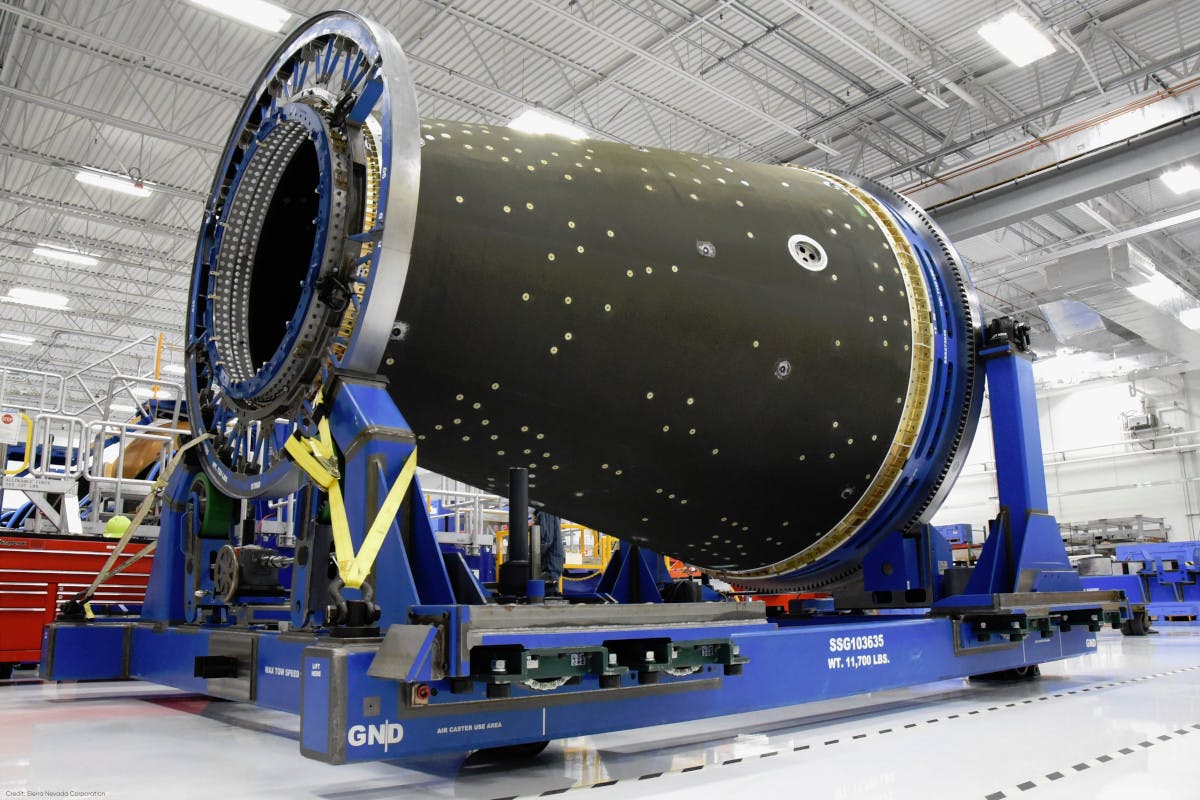
In particular, SNC’s Shooting Star transport vehicle serves as the core structure for the proposed design.
The versatility of the Dream Chaser spaceplane and Shooting Star technologies and subsystems allow for greater flexibility and modularity both internally and externally for orbital outpost mission requirements. For DIU, this design leverages commercial programs and private investment at a fraction of the cost and schedule of building government-owned and operated systems. Repurposing space hardware reduces the time to achieve a minimal operating capability, orbital debris and the cost of launching dedicated buses to support subsequent mission requirements.
“We’re excited by the multi-mission nature of Shooting Star,” said SNC CEO Fatih Ozmen. “It was originally developed for NASA resupply missions to the International Space Station, and since then we keep identifying new capabilities and solutions it offers to a wide variety of customers. The possible applications for Shooting Star are really endless.”
Shooting Star is a 16-foot attachment to Dream Chaser developed for NASA Commercial Resupply Services 2 (CRS-2) missions to provide extra storage for payloads and to facilitate cargo disposal upon re-entry into Earth’s atmosphere. However, the transport vehicle’s unique design also offers free-flyer and satellite capabilities for large payloads with high-power capacity. It can also support logistics services to low-Earth orbit (LEO) and cislunar destinations.
“The current Shooting Star is already designed with significant capabilities for an orbital outpost and by adding only a few components we are able to meet Department of Defense needs.” said former NASA space shuttle commander and retired USAF pilot Steve Lindsey, now senior vice president of strategy for SNC’s Space Systems business area. “We are proud to offer our transport vehicle to DoD as a free-flying destination for experimentation and testing, expanding beyond its current payload service capabilities for Dream Chaser cargo missions.”
The proposed orbital outpost will be initially established in LEO with guidance, navigation and control for sustained free-flight operations to host payloads and support space assembly, microgravity, experimentation, logistics, manufacturing, training, test and evaluation. Future outposts may be based in a variety of orbits including, medium-Earth orbit, highly elliptical orbit, geosynchronous Earth orbits (GEO) to include GEO transfer orbits, and cislunar orbits.