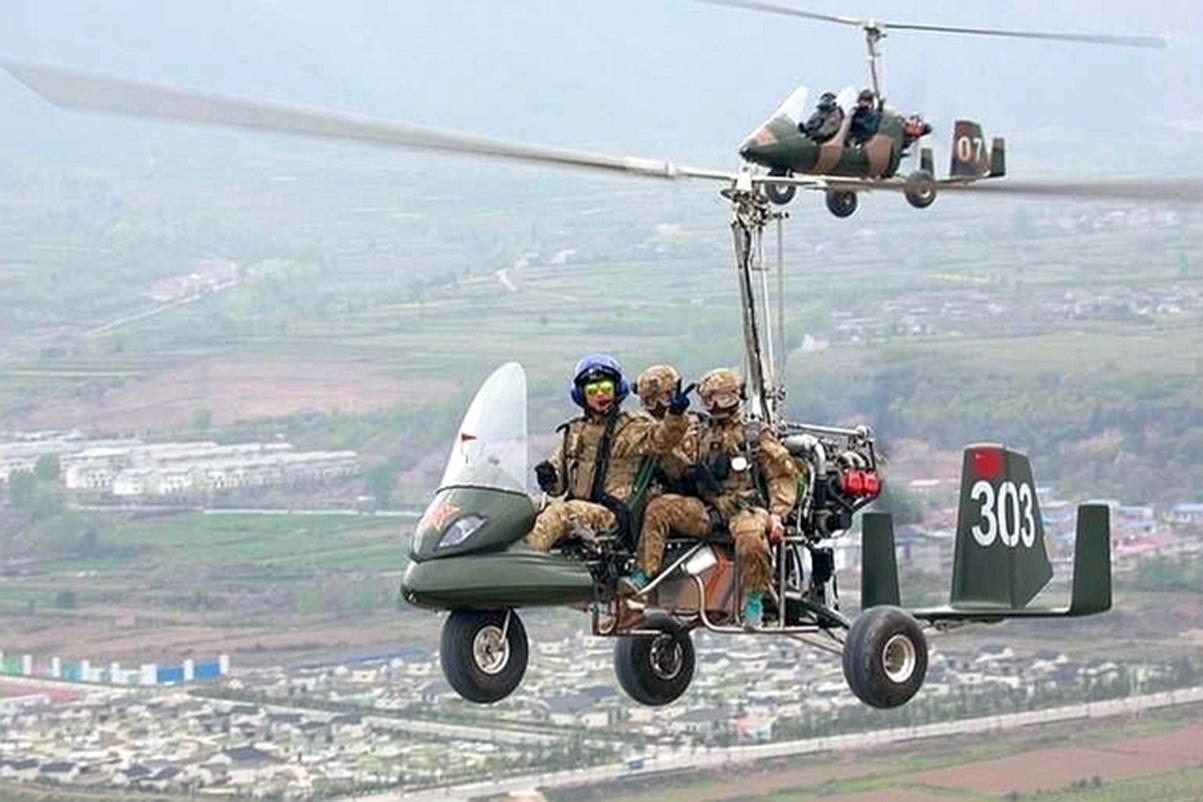
Belarusian special operations troops have begun using Belarusian-built “Yastreb” gyroplanes in a new phase of flight training exercises, according to official footage released from Maryina Horka, a key training ground for elite units.
The training involved low-altitude group flights, air reconnaissance, cargo drops, and personnel transport simulations.
According to Belarusian military officials, the Yastreb is designed for missions in operational environments where the use of large helicopters or fixed-wing aircraft is not feasible.
Military crews operating the Yastreb carried out flights at very low altitudes and rehearsed various tactical scenarios, including aerial scouting and rapid supply delivery. As noted by Belarusian state media, the gyroplane is now being formally integrated into the toolset of special operations units.
The aircraft, jointly developed and manufactured by Belarus and China, is a lightweight two-seat gyroplane tailored for reconnaissance, casualty evacuation, and border patrol. The Yastreb’s modular design allows it to function in dense forests and rugged terrain, making it a suitable alternative to conventional helicopters in restricted environments.
The gyroplane uses the aerodynamic principle of autorotation, where a freely spinning rotor blade generates lift as it interacts with the surrounding airflow. The aircraft has a maximum flight endurance of up to six hours when equipped with dual 120-liter fuel tanks. Its top speed is listed at 200 km/h.
According to technical specifications released by the manufacturer, the Yastreb has an empty weight of 335 kg and a maximum takeoff weight of 560 kg. Its cabin width is 1,360 mm, and the aircraft can carry a payload of up to 265 kg. The platform’s small footprint and low acoustic signature make it particularly useful for missions requiring discretion and maneuverability at low altitudes.
In a statement published by Belarusian defense authorities, the Yastreb was described as a flexible airborne platform suited for both civil and military applications. The military emphasized its role in search-and-rescue operations, reconnaissance patrols, and rapid transport missions along the national border.
China has also invested in rotary-wing ultralight aviation, including gyroplanes, as part of its efforts to diversify aerial reconnaissance and tactical transport capabilities in difficult terrain. The Yastreb reflects growing cooperation between China and Belarus in light aviation manufacturing and defense-related technology transfers.
While Belarus has yet to announce how many gyroplanes will be introduced into regular service, the training suggests an intent to expand their operational role beyond testing.