

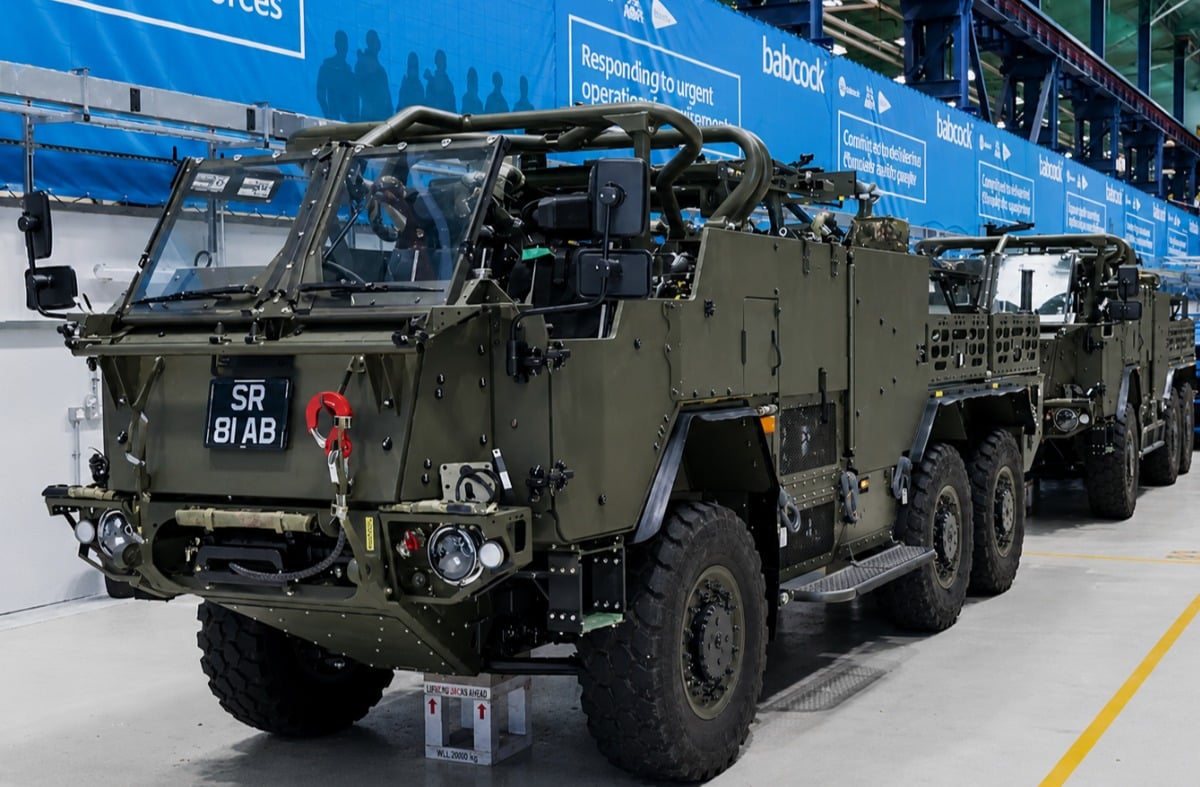
- Babcock completed delivery of 123 Jackal 3 and Jackal 3 Extenda vehicles to the British Army on July 13, 2026.
- The program was built in partnership with Supacat at Babcock's Devonport facility, with the Ministry of Defence holding an option for up to 240 total vehicles.
Babcock International has finished building the last of 123 Jackal 3 high-mobility vehicles for the British Army, with the final vehicle, a six-wheeled Extenda variant, rolling off the production line at the company’s Devonport facility in Plymouth and now heading into testing before it joins the Army’s operational fleet.
The Jackal has been a fixture of British Army operations since it first deployed to Afghanistan in April 2008 with 16 Air Assault Brigade and the Royal Marines’ 3 Commando Brigade, where it replaced older Land Rover-based patrol vehicles that struggled to keep pace with the demands of deep battlespace reconnaissance and rapid-response missions. Designed by Supacat, a defense engineering firm based in Honiton, Devon, the vehicle earned a reputation among troops for off-road performance that some crews likened to a dune buggy, built on a chassis manufactured under license from Lockheed Martin and paired with a Cummins engine, an Allison transmission, and Fox Racing Shox suspension components more commonly associated with off-road motorsport than military procurement.
The completed program covered two separate tranches, with Babcock and Supacat first delivering 70 standard four-wheeled Jackal 3 vehicles before shifting production to 53 of the six-wheeled Extenda variant, known as the Jackal 3(E), which adds a third axle to increase payload capacity while preserving the platform’s off-road mobility. That extra axle lets the vehicle carry a gross weight of up to 7,600 kilograms (16,755 pounds) with a maximum payload of 2,100 kilograms (4,630 pounds), reach speeds up to 120 kilometers per hour (75 mph), and operate across a road range of roughly 800 kilometers (497 miles), specifications that put it well ahead of the original Jackal variants introduced nearly two decades ago. Depending on mission requirements, crews can fit the vehicle with a 12.7mm heavy machine gun, a 7.62mm general-purpose machine gun, or a 40mm automatic grenade launcher, along with optional mine blast and ballistic protection kits developed by Jankel Armouring.
“The British Army needs a highly practical weapons platform with exemplary off-road performance, and with Supacat’s Jackal 3, we’ve delivered a fleet of vehicles that meets this requirement,” said Louise Atkinson, Chief Executive, Land and Mission Systems, Babcock.
“To have reached this milestone demonstrates Babcock’s commitment and expertise in delivering high-quality military vehicles to the armed forces. This critical programme required a large amount of collaboration, and I’d like to thank everyone for their tireless work in making it a success,” Atkinson said.
The scale of this delivery matters because it comes at a moment when the British Army has been actively replenishing its light vehicle fleet after sending a portion of its existing Jackal stock to Ukraine as military aid earlier in the war, a decision that left gaps in a platform the Army treats as central to reconnaissance, patrol, and fire support missions across its light forces. Parliamentary figures released in June 2026 put the total Jackal fleet at 639 vehicles in British Army service, alongside 61 operated by the Royal Marines, with the Ministry of Defence retaining an option under the broader contract to procure up to 240 Jackal 3 vehicles in total depending on future operational demand, meaning this 123-vehicle delivery represents roughly half of what the program could ultimately produce if the Army exercises its full order.
“We are all delighted to have collaborated with Babcock on the successful manufacture and delivery of this important British Army programme,” said Phil Applegarth, Director, Head of Supacat.
“By combining Babcock’s extensive expertise in defence support and production with our own innovative design capabilities and agile approach, we have delivered together the latest Jackal variants to the British Army. This programme is a great example of what can be achieved through strong collaboration, and we are incredibly proud to have played a role in enhancing the Army’s fleet with these highly capable vehicles and supporting UK defence,” Applegarth said.
Devonport sits within a designated Freeport zone that offers tax and customs incentives for manufacturers, and Babcock has said the Jackal 3 program supports skilled engineering jobs across the South West of England, drawing nearly all of its supply chain from within the UK and roughly half specifically from the South West region.
“This marks a significant milestone with the completion of the Jackal 3 (Extenda) platform build programme. Building on the successful delivery of the initial 70 Jackal 3 vehicles, this enhanced capability reflects our continued commitment to providing the Army with highly capable, adaptable mobility on operations,” said Major General Lizzie Faithfull-Davies, Director Land Environment, National Armaments, Material.
“This achievement is testament to the strength of our enduring partnership with Babcock and Supacat. Their responsiveness, engineering expertise and collaborative approach has been central to delivering a platform that meets operational needs while maintaining pace and quality. We look forward to continuing this close relationship as we develop and sustain capability into the future,” Faithfull-Davies said.
Defence Minister Lord Coaker tied the completed program directly to the government’s broader Defence Investment Plan, framing vehicle production as inseparable from the industrial base that sustains it.
“These vehicles, built right here in Devonport, will give our forces one of the most capable high-mobility platforms available. The Defence Investment Plan reconfirms the vital role that land vehicles play in our armed forces’ capability, ensuring land forces can seize or defend ground in all environments and conditions. It is exactly this kind of collaboration between British industry and our armed forces that helps support local industry and demonstrates that defence is an engine for growth,” Coaker said.