

- The UK Ministry of Defence published an RFI on May 27, 2026, seeking missile silo concepts capable of 30-day autonomous readiness aboard crewed and unmanned naval vessels.
- The RFI requests compatibility with CAMM and ASTER missile families and 90% component commonality across maritime and land domain variants, with responses due July 13, 2026.
Britain’s military is exploring a radical new concept for its naval missile defenses, one where warships and robotic vessels can sit armed and ready to fire for a month at a time with nobody on board to maintain them, and the UK Ministry of Defence is now asking the defense industry to help figure out how to build it.
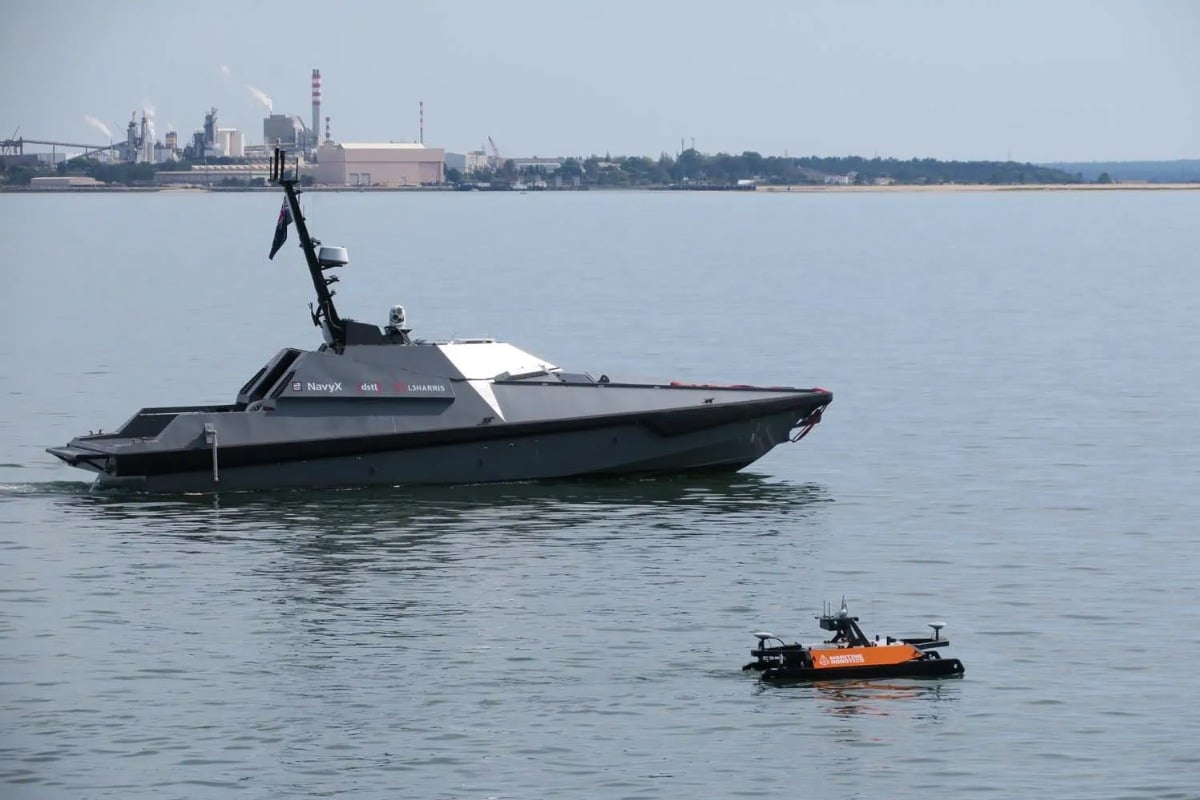
The UK Ministry of Defence’s National Armaments Director Group published a Request for Information, seeking industry ideas for next-generation missile launcher systems capable of operating aboard both crewed warships and unmanned surface vessels, the robotic ships that Britain’s military has branded the Hybrid Navy, its vision for a future fleet that blends human-operated and autonomous platforms into a single integrated fighting force. Responses are due by July 13, 2026, after the original deadline was extended by approximately six weeks from the initial return date. The document, classified at the Official level under British government security markings, asks defense companies to submit concepts for missile silos that can sustain what the Ministry describes as “prepared for firing” status for a minimum of 30 days without any physical human interaction.
That 30-day autonomous readiness requirement is the most operationally significant specification in the document, because it defines what the Hybrid Navy concept actually demands from its weapons systems at a fundamental level. A missile launcher that requires a crew member to perform daily checks, monthly maintenance cycles, or any physical intervention to remain in a safe and ready-to-fire state simply cannot function aboard an unmanned vessel operating without personnel for extended periods. Current naval vertical launch systems, the magazine-style cells built into the decks of modern frigates and destroyers that hold and fire missiles of various types, were designed with the assumption that trained sailors would be nearby at all times, performing routine checks, responding to faults, and physically validating the system’s readiness before any firing event. Removing that human element entirely while maintaining the same standard of combat readiness requires engineering solutions that the existing generation of naval missile launchers was never designed to provide.
The missiles the new silos need to accommodate include the CAMM family, which stands for Common Anti-air Modular Missile, a British-developed air defense interceptor built by MBDA that is already in service with the Royal Navy under the Sea Ceptor designation, capable of engaging aircraft, helicopters, and cruise missiles at ranges up to approximately 25 kilometers (15 miles). The document also references the ASTER family, the Franco-Italian air defense missiles produced by MBDA that include the Aster 15 with a range of roughly 30 kilometers (19 miles) and the longer-range Aster 30, with its Block 1NT variant capable of engaging ballistic missiles at extended ranges. Both families represent the current standard of British and allied naval air and missile defense capability, and the new silo concepts need to be compatible with them while also being designed to accept future effectors whose specifications have not yet been finalized.
Beyond the autonomous readiness requirement, the Ministry’s document reveals a broader ambition for the new silo architecture that extends well beyond the naval domain. The RFI asks about launcher concepts that achieve 90 percent component commonality between maritime and land-based variants, a specification that would allow the same fundamental silo design to be deployed on warships, unmanned surface vessels, wheeled vehicles, and fixed ground installations using shared components, supply chains, and maintenance procedures across all of those applications. That level of cross-domain commonality would represent a significant simplification of the United Kingdom’s integrated air and missile defense logistics and would align with the broader NATO push to standardize air defense components across member states who increasingly need to share spare parts, training, and technical expertise.
The document also raises the question of containerization, asking whether silo concepts can be designed to fit into standard shipping container form factors that would minimize the platform integration work required to mount them on different vessel types. A containerized missile launcher that can be bolted onto a deck or dropped into a standard mounting well rather than permanently integrated into a ship’s structure would allow the Royal Navy and its Hybrid Navy unmanned vessels to be rearmed or reconfigured far more rapidly than is possible with today’s fixed vertical launch systems, and could potentially allow the same silo modules to be transferred between ships or repositioned from maritime to land roles without specialized equipment or major engineering work.
The reloading problem receives specific attention in the document, with the Ministry asking about concepts for replacing entire empty silo modules in a single operation rather than reloading individual cells one at a time, the current standard approach that is slow and labor-intensive under the best conditions and practically impossible under combat conditions at sea. Solutions for replenishment at sea and replenishment in foreign ports are explicitly requested, acknowledging that a Hybrid Navy operating across extended distances needs to be able to rearm without returning to a home base between engagements.
Britain’s investment in the Hybrid Navy concept reflects the lessons that Western navies have drawn from observing how unmanned systems have performed in conflicts including the war in Ukraine, where Ukrainian naval drone attacks repeatedly demonstrated that small, autonomous surface vessels could conduct effective strikes against a significantly larger conventional navy. The Royal Navy has been among the most aggressive advocates within NATO for integrating unmanned platforms into its fleet structure, and the IAMD silo RFI represents one of the most technically demanding aspects of that integration: not just adding unmanned platforms to the fleet, but ensuring those platforms can carry the same offensive and defensive weaponry as their crewed counterparts and hold it ready for combat without a single sailor aboard.