

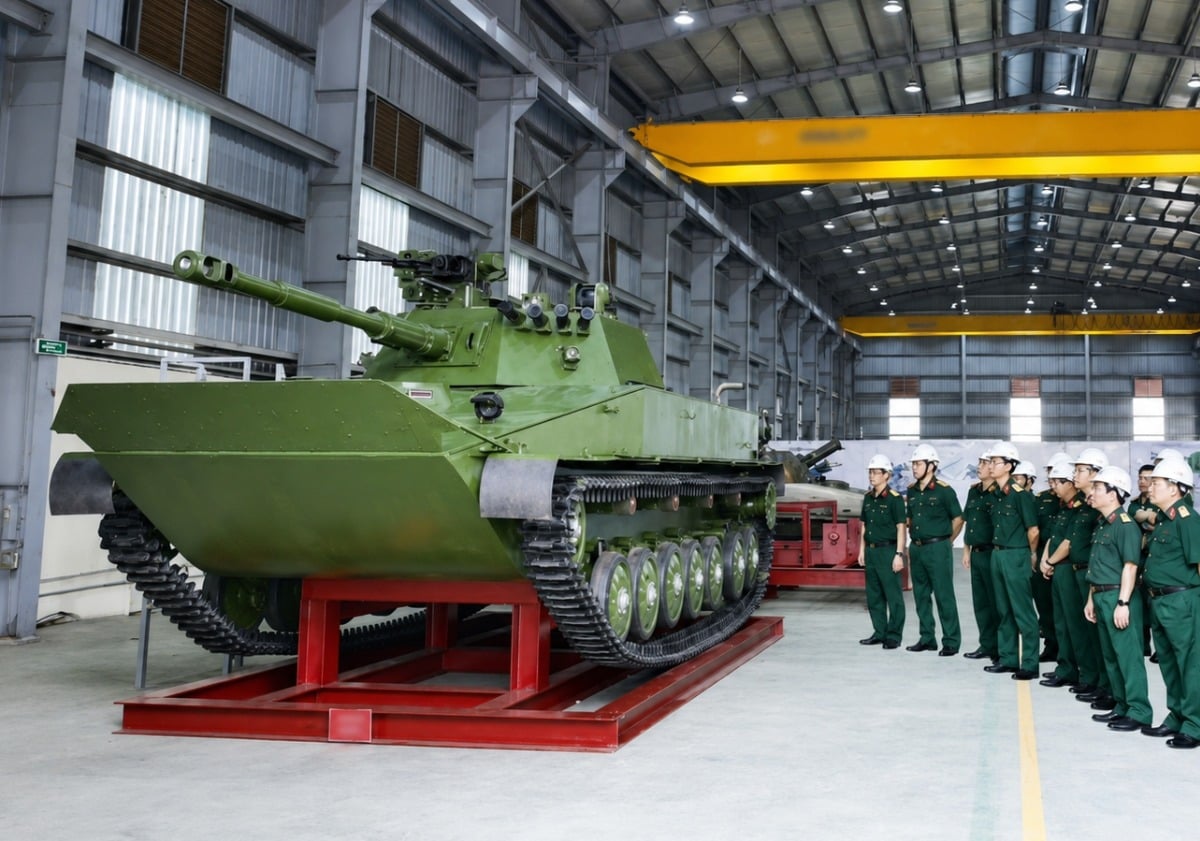
- Vietnam publicly displayed the T-1 amphibious light tank prototype, featuring a 76 mm autoloaded cannon, 470-horsepower diesel engine, and 80 km/h (50 mph) road speed.
- The T-1 hull runs seven road wheels per side, weighs approximately 4 tonnes more than the Soviet PT-76B it conceptually succeeds.
Vietnam has publicly displayed the T-1, a domestically developed amphibious light tank that represents the most ambitious armored vehicle project the country’s defense industry has ever attempted.
The T-1 prototype appeared at a public display in Vietnam, drawing immediate attention from regional military observers for what it signals about Hanoi’s defense industrial ambitions as much as for the vehicle’s specific capabilities. Vietnam’s Ministry of National Defense has been pushing an explicit policy of military modernization and domestic defense production for several years, seeking to reduce dependence on foreign suppliers, diversify away from its historically dominant reliance on Russian equipment, and build an indigenous defense industry capable of sustaining the Vietnamese People’s Army with locally produced platforms. The T-1 is the most visible product of that effort in the armored vehicle domain.
The conceptual lineage of the T-1 runs directly to the Soviet PT-76B, the amphibious light tank that Vietnam operated extensively during the wars of the twentieth century and which remains in limited service today. The PT-76, introduced in the early 1950s, was a revolutionary design for its time, combining the ability to cross rivers and coastal waters under its own propulsion with enough firepower to support infantry operations in terrain where heavier tanks could not follow. Vietnam used the PT-76 to devastating effect during the 1968 Battle of Ben Het and in the 1975 final offensive, and the vehicle left a deep institutional imprint on Vietnamese armored doctrine. The T-1 takes that conceptual foundation and rebuilds it on a substantially more capable modern chassis.
The most immediately visible difference between the T-1 and its Soviet predecessor is the hull length. The T-1 runs seven road wheels per side, compared to the PT-76B’s six, reflecting a lengthened hull that provides additional internal volume for modern systems, larger fuel capacity, and improved buoyancy margins for the amphibious role. That added length comes with a weight penalty of approximately 4 tonnes compared to the PT-76B, a tradeoff the designers accepted in exchange for the expanded capability the larger hull enables. The engine driving the T-1 is a 470-horsepower diesel, giving the vehicle a power-to-weight ratio sufficient to achieve a maximum road speed of approximately 80 km/h (50 mph), a figure that places it at the faster end of the light tank category and well above the cross-country mobility of most main battle tanks.
The two-person turret houses a 76 mm cannon fitted with a mechanized autoloader, eliminating the need for a dedicated human loader and allowing the crew to maintain a higher rate of fire with less physical exertion during sustained engagements. A 76 mm caliber is lighter than the 100 mm or 125 mm guns found on main battle tanks, but for a light amphibious platform designed to support infantry and engage light armor and fortified positions rather than fight other heavy tanks, it represents an appropriate balance between lethality and the weight constraints that amphibious performance imposes. The turret also mounts a coaxial machine gun for use against personnel and light vehicles, and the vehicle carries a remotely operated weapon station, a separately aimed weapon mount controlled from inside the vehicle without exposing a crew member, on the hull roof.
Vietnam’s geography makes the amphibious capability of the T-1 particularly relevant to national defense planning. The country’s coastline stretches more than 3,200 km (2,000 miles), and its interior is crossed by major river systems including the Mekong Delta in the south, a region of channels, rice paddies, and flooded terrain where wheeled and tracked vehicles without swimming capability are severely constrained. An amphibious light tank that can cross water obstacles without engineering support and then engage targets on the far bank gives Vietnamese ground forces a tactical flexibility that heavier, non-amphibious armor cannot provide in that environment.