

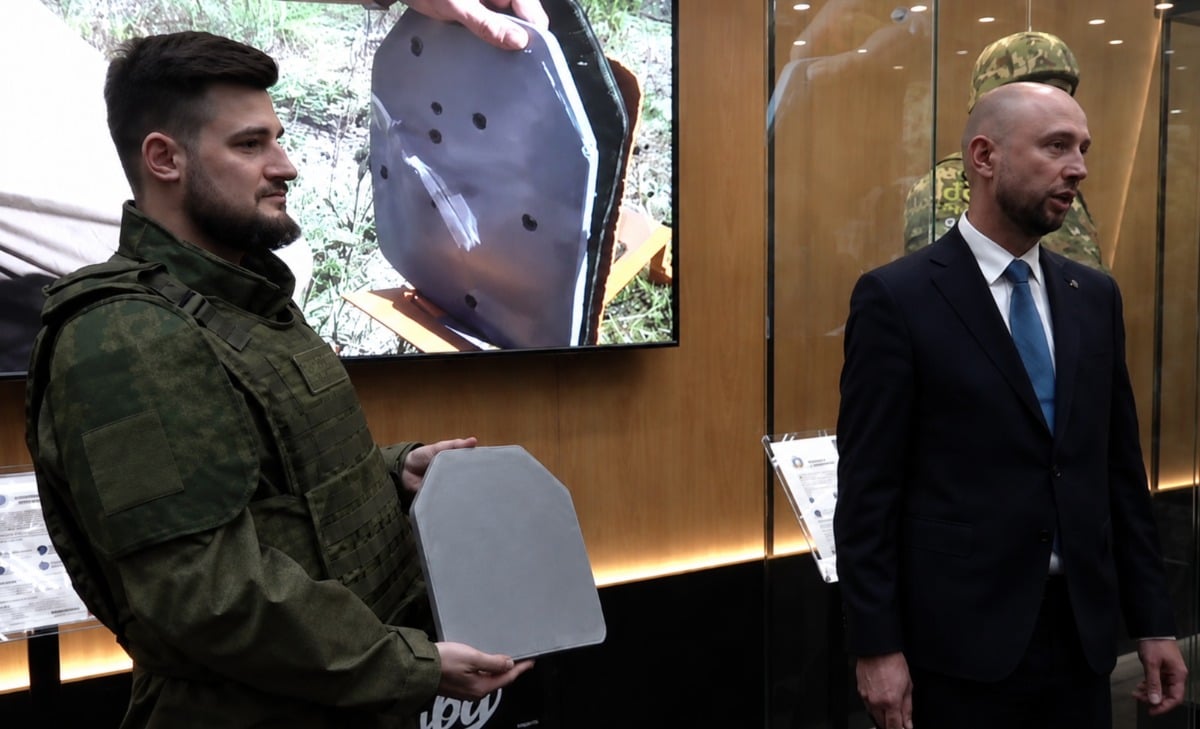
- Rostec demonstrated the Obereg 2.0 body armor, Zubr counter-drone system, Molniya UAVs, and Kalashnikov loitering munitions to CSTO defense ministers at Patriot park in Russia.
- The Obereg 2.0 vest weighs 7.5 kg and is claimed to stop more than 20 rounds of NATO 5.56x45 mm ammunition; it is currently undergoing trials.
Russia’s state defense conglomerate Rostec has unveiled what it claims is the lightest body armor in its class, presenting the Obereg 2.0 vest to the defense ministers of Moscow’s closest military allies at a showcase outside the Russian capital.
Russian Defense Minister Andrei Belousov led a delegation of defense ministers from the Collective Security Treaty Organization, the Moscow-led military alliance grouping Russia with Armenia, Belarus, Kazakhstan, Kyrgyzstan, and Tajikistan, through Rostec’s demonstration center at the Patriot military park. The centerpiece of the personal protection display was the Obereg 2.0, developed and manufactured by Rostec’s Oktava plant, a facility with a long history of producing personal protective equipment for Russian security and military forces.
Rostec describes Obereg 2.0 as the lightest vest in its class, weighing 7.5 kg (16.5 lb). That weight figure is significant in the context of modern infantry combat, where soldiers already carry weapons, ammunition, communications equipment, water, and rations that can push total load well above 30 kg (66 lb). Every kilogram saved on body armor is a kilogram available for mission-critical equipment, or simply a reduction in the physical burden that degrades combat performance over hours and days in the field. Despite its reduced weight, Rostec says Obereg 2.0 provides greater fragment protection coverage than the Russian military’s current standard-issue vest, which would represent a meaningful advance if the claim is borne out by independent testing.
The armor plates integrated into Obereg 2.0 are rated to protection class Br4-plus under Russian armor classification standards. The Russian Br scale measures resistance to ballistic threats across a range from Br1, which stops low-velocity pistol rounds, through Br6 and beyond, which resist high-powered rifle fire and armor-piercing ammunition. Br4 corresponds broadly to protection against standard rifle cartridges at combat distances, while the plus designation indicates performance exceeding the baseline Br4 requirement. A plant representative stated that the armor panel has high survivability and stops more than 20 rounds of NATO 5.56×45 mm (0.22 in) ammunition before structural failure, a figure that addresses one of the most operationally relevant threat scenarios Russian forces currently face.
The choice of NATO 5.56×45 mm as the test benchmark is not incidental. That cartridge powers the M16 and M4 family of assault rifles that forms the backbone of U.S. Army infantry weapons, and it has been supplied to Ukrainian forces in large quantities through Western military aid packages. Russian forces have encountered it daily since the full-scale invasion of Ukraine began in February 2022, making resistance to that specific round a direct operational requirement rather than a theoretical specification exercise. Claiming that the vest stops more than 20 such rounds before losing protective integrity is a pointed performance statement aimed squarely at the threat environment Russian soldiers actually inhabit. Those claims have not been independently verified and should be treated as Rostec’s assertion pending confirmation through third-party testing.
The survivability of armor under repeated impact is a technically important and often underappreciated dimension of body armor performance. A vest that stops the first round but shatters its ceramic plate in doing so offers no protection against a second hit to the same location, a scenario that is far from hypothetical in close-quarters combat or when a soldier comes under sustained fire. Modern high-performance armor plates are typically made from boron carbide or silicon carbide ceramics, sometimes backed by ultra-high-molecular-weight polyethylene, and their ability to remain structurally intact across multiple impacts depends heavily on the plate’s design, thickness, and the backing material behind it. Rostec’s claim of stopping more than 20 rounds speaks directly to that multi-hit survivability question, though the specific plate geometry, ceramic composition, and test conditions behind that figure have not been disclosed.
Obereg 2.0 is currently undergoing trials and has not yet entered series production. The ministerial demonstration at Patriot park suggests Rostec is positioning the vest for imminent procurement decisions within CSTO member states, using the alliance’s defense ministers as both an audience and a potential customer base. For Russia itself, the practical path from successful trials to frontline issue involves production scaling at the Oktava plant, a logistics chain capable of distributing equipment across an army engaged in active combat operations, and integration into the broader personal protective equipment system that includes helmets, ballistic eye protection, and load-bearing equipment designed to work together with the vest.
Whether Rostec’s Obereg 2.0 claims will survive independent testing remains an open question. Russia’s defense industry has a recent and well-documented pattern of announcements that collapse on contact with reality. In January 2025, drone manufacturer Transport of the Future CEO Yury Kozarenko personally walked Putin through his Tolyatti plant, promised 300,000 drones a year, and was treated as a symbol of Russian industrial mobilization. By May 2026, he was in pretrial detention on large-scale fraud charges, with investigators alleging state defense funds were diverted to shell companies, and pro-war Russian Telegram channels reporting the firm had been selling Chinese-made drones as Russian-developed products. The showcase, the billions in announced investment, the production promises — none of it was real. Rostec’s vest may prove different.