

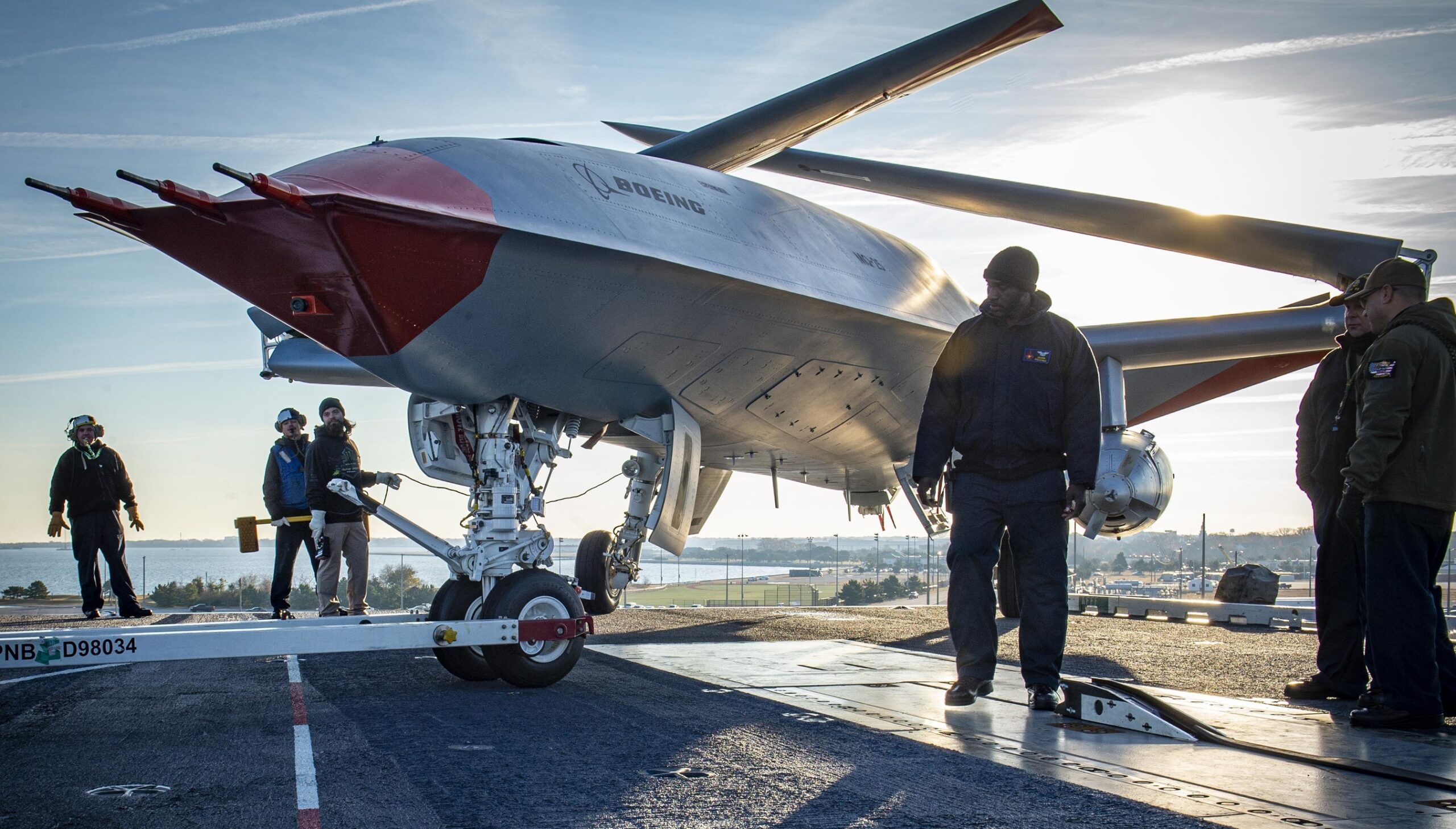
The U.S. Naval Air Systems Command announced last week that the Navy’s Unmanned Carrier Aviation program office (PMA-268) conducted its first lab integration event June 28-30 at Pax River to demonstrate how the MQ-25’s Ground Control Station (GCS) will command the unmanned aircraft in the carrier environment.
The government team and its two prime industry partners led the effort at the program’s System Test and Integration Lab (STIL), where Lockheed Martin’s GCS controlled Boeing’s Hardware-in-the-Loop (HITL) air vehicle for the first time. The HITL utilizes aircraft hardware and software to provide a realistic surrogate for the air vehicle.
“This achievement is the result of weeks of preparation and dedication by highly skilled teams,” said TJ Maday, MQ-25 labs and integration manager. “Bringing multiple systems together is never easy, but the joint government/industry team, coming together, understanding problems and finding solutions made this event successful. We learned how the system works as a whole and that early learning and discovery is key to keep the program moving forward.”
Maday said the team set a goal to send a basic command between the GCS and the HITL. In order to meet that objective, Boeing and Lockheed Martin needed to deliver functional software for the government to exercise the GCS, the HITL and the network components allowing connectivity between the systems.

“The team met the initial goal ahead of schedule and used the remaining time to exercise more functionality like sending taxi commands,” Maday said. “They also simulated a lost link that verified the proper GCS display indicators, which is a critical function to ensure network connectivity between development environments.”
This fall the team plans to simulate a complete flight using the HTIL air vehicle and will also demonstrate switching connections “links” to the aircraft as well as adding other aircraft hardware and software into the mix.
“It’s great to see the combined team working side-by-side, learning and ultimately demonstrating success,” said Capt. Sam Messer, PMA-268 program manager. “This is how we get to IOC [Initial Operational Capability]—we integrate, test, and learn early and at pace.”
The MD-5 GCS is part of the Unmanned Carrier Aviation Mission Control System (UMCS), the system-of-systems required for MQ-25A command and control. UMCS also includes carrier and shore site infrastructure modifications, Navy produced ancillary equipment, and integration with command, control, communications, computers and intelligence (C4I) systems.
MQ-25 will be the world’s first operational carrier-based unmanned aircraft to provide an aerial refueling capability to the fleet.