

The Joint Modernization Command conducted media day at the on Yakima Training Center on April 30.
JMC leadership introduced the media to Joint Warfighter Assessment 19, which is the U.S. Army’s largest annual joint-multinational live exercise in which the U.S. military and partner nations assess 28 future warfighting concepts, capabilities and formations in a large-scale and realistic battlefield exercise.
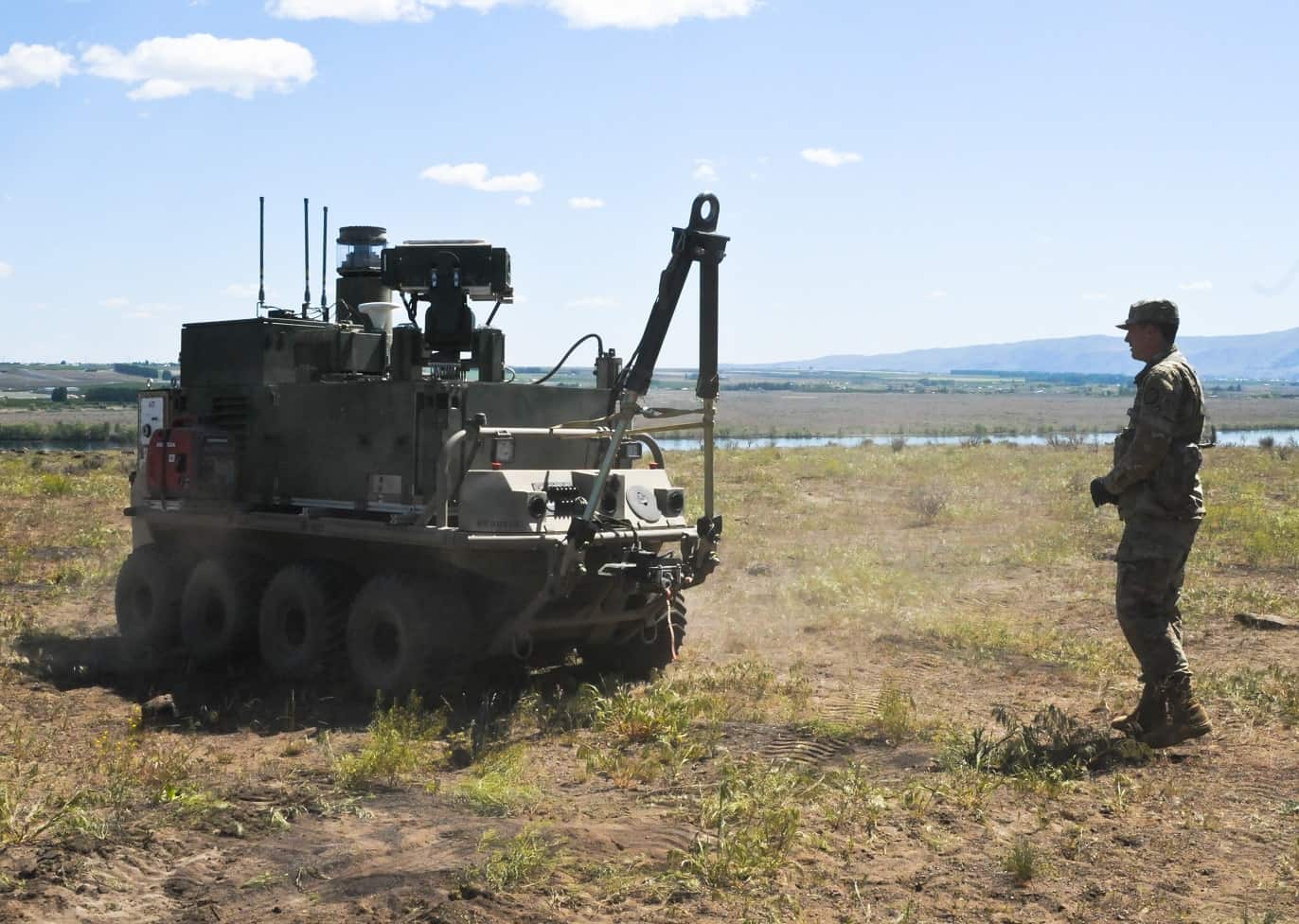
The U.S. Army also unveiled during live exercise the concept of a newest unmanned Nuclear, Biological, Chemical Reconnaissance Vehicle (NBCRV) that designed to provide nuclear, biological and chemical detection and surveillance for battlefield hazard visualization.
For soldiers entering into a combat zone, there is always the fear of the unknown. An enemy could have employed dangerous chemical, biological, radiological, or nuclear weapons on the battlefield, and soldiers might not find out until it’s too late.
To help alleviate some of this worry, Chemical, biological, radiological and nuclear defense (CBRN) Soldiers investigate potential CBRN threats at close range from a slow-moving or completely stopped vehicle, sometimes directly exposing the vehicle to the threat in order to conduct sampling and often creating an easy target for the enemy.
The UGV with CBRN chemical detection sensors will eliminate the need to expose soldiers during such operations. The new vehicle can be remotely operated from more than a mile away and detects and collects chemical and biological contamination in its local environment.
The new unmanned ground vehicle, with CBRN chemical detection sensors, will provide situational awareness to increase the combat power of the Stryker Brigade Combat Team (SBCT).
“We’re asking the leaders of today to fight in the future, and in all environments,” said Brig. Gen. Johnny Davis, commander of the military’s Joint Modernization Command based at Fort Bliss, Texas during exercise.
Future military operations will involve satellites orbiting the Earth; naval, air and land forces; and actions in cyberspace, Davis said.
Military officials invited journalists to observe some of the technology that soldiers were trying out during the exercises. Davis said the activity at the training center was to have soldiers to see what worked and what didn’t out in the field.
Scott Gourley released on its Twitter account short video showed the new UGV, called robotic CBRN concept vehicle.
Robotic CBRN concept vehicle at this week’s #USArmy Joint Warfighting Assessment ‘19 at Yakima Training Center @ShephardNews pic.twitter.com/6FoS03zmGU
— Scott Gourley (@ScottGourley1) May 1, 2019