

The UK has been working with the US military on autonomous resupply, providing a glimpse into the future of getting much-needed supplies to the front line.
In exercise in Michigan, the UK MOD’s Defence Science and Technology Laboratory (Dstl) and organisations from the US Army’s Research, Development and Engineering Command (RDECOM) have been testing an all-terrain 4×4 vehicle controlled by an Xbox-style controller, driverless trucks in convoy and Hoverbike drones for delivering supplies in the most dangerous “last mile” up to the battlefield.
Defence Minister Harriett Baldwin said:
One hundred years ago we pioneered tank warfare with our US allies, and today we remain right at the forefront of military technology together. This exercise has proven the success of our ongoing investment in science and technology as we see concepts becoming reality. This particular project is spearheading solutions to the notoriously dangerous operation of supplying our frontline on the battlefield. Delivering crucial food, fuel and ammo remotely will help save soldiers’ lives.
This is a new way of coordinating and delivering vital supplies to front-line operations, aiming to reduce risk to those troops and provide on-demand delivery of food, fuel or ammunition to the front line. The Coalition Assured Autonomous Resupply (CAAR) demonstration, the first in a three-year project to bring concepts to life, marked initial demonstration of unmanned tactical resupply technologies in the three areas.

The line-haul convoy is the first time ever that a UK-US collaboration has joined together in this format, with a British Army MAN SV 6-tonne truck as a ‘leader’ vehicle in the convoy, followed by two US Light Medium Tactical Vehicles (LMTV) trucks. Travelling at speeds of up to 25mph, the vehicles used integrated robotics to make decisions about speed, steering and other driving functions.
The Unmanned Aerial Vehicles (UAVs) demonstrated included the British-developed Malloy Aeronautics Hoverbike. An advanced prototype quadcopter drone, it can deliver more than 100kg of supplies, using a simple tablet controller. Unveiled for the first time, this version of the Hoverbike could also potentially be used for humanitarian aid and disaster relief missions.
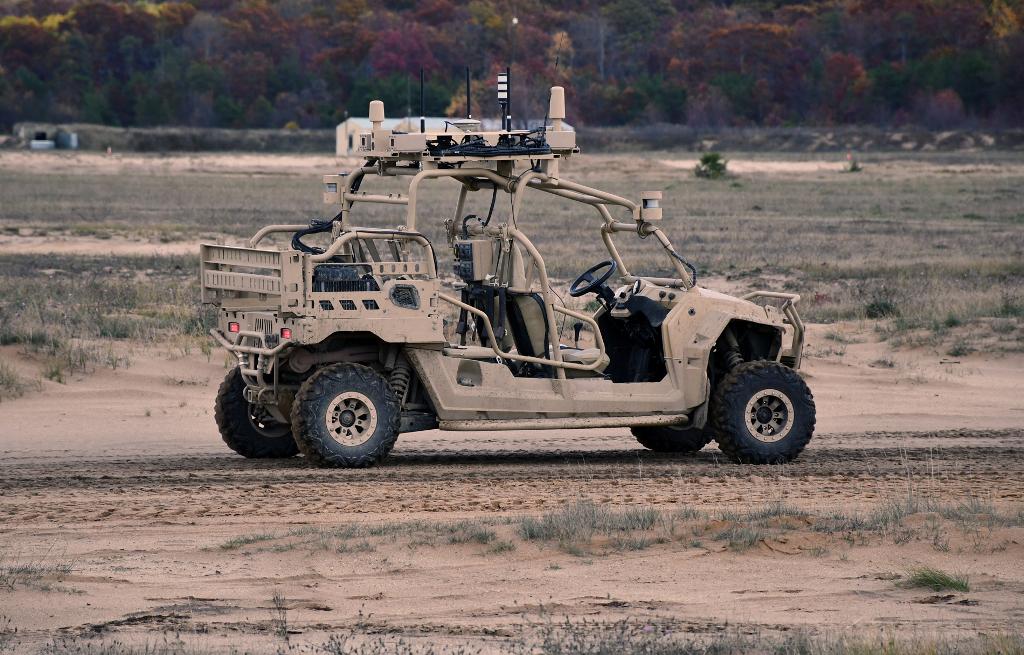
The 4×4 vehicle tested was a tele-operated Polaris MRZR, fitted with advanced sensors, cameras and GPS, and operated by a joint UK-US trials team. Using an adapted Xbox game console controller, Corporal Mortimer and Lance Corporal Thorne remotely ‘drove’ the 4×4 around the area to simulate an off-road task.
Under the Autonomous Last Mile resupply challenge, Dstl and the Defence and Security Accelerator (DASA) are bringing together a wide range of military and industry partners to join commercial-off the-shelf (COTS) suppliers with novel ideas and tech start-ups in producing a futuristic demonstration of how UK and US forces’ tactical resupply might one day operate.