

- Zelenskyy told The Guardian that Britain, France, and Germany agreed to help Ukraine with anti-ballistic missile defense during June 7 Downing Street talks with Starmer, Merz, and Macron.
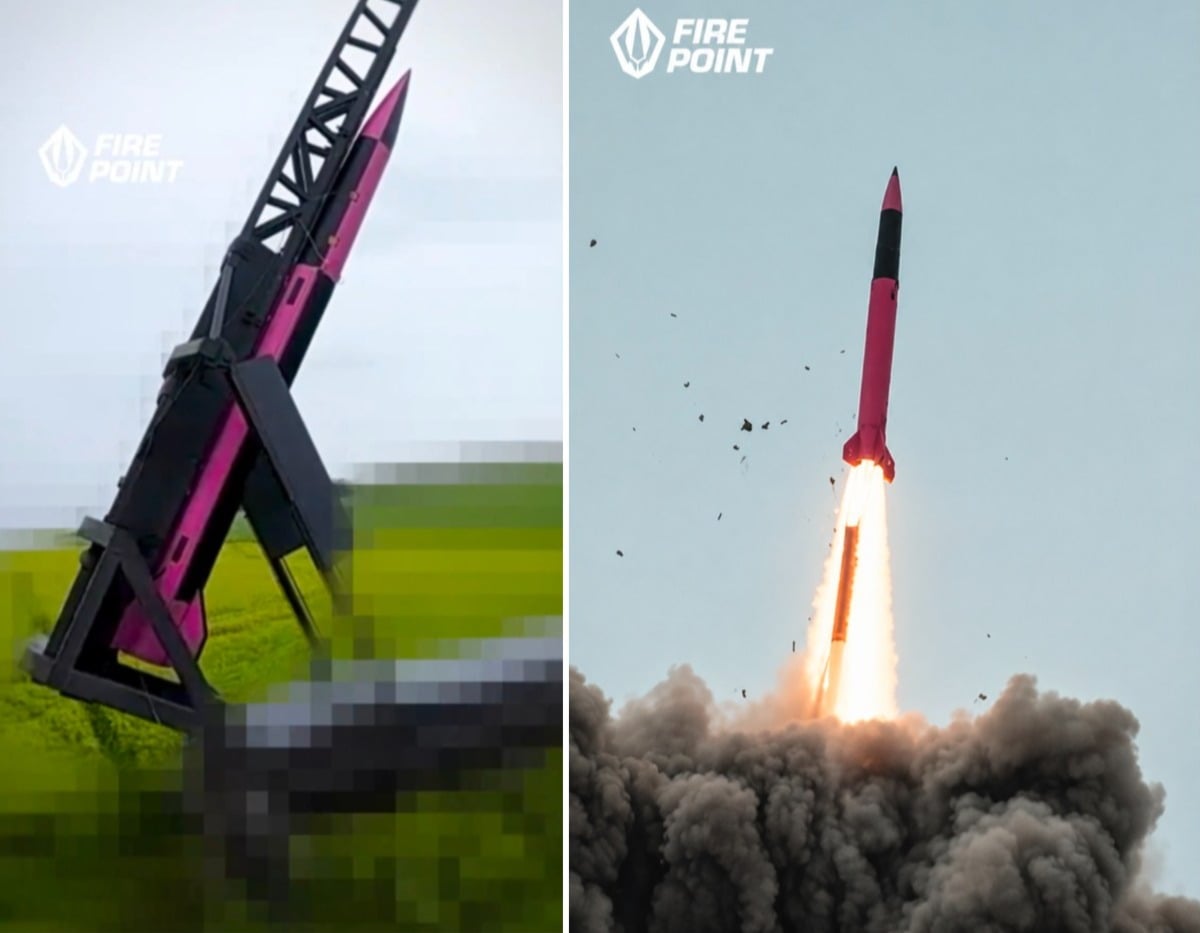
- Ukrainian firm Fire Point is developing the FP-7.X interceptor missile, targeting a cost below $1 million per unit, with a full air defense system planned by 2027
Ukrainian President Volodymyr Zelenskyy said in an interview with The Guardian that Britain, France, and Germany have agreed to help Ukraine with anti-ballistic missile defense, a commitment extracted during talks at Downing Street on June 7, where Zelenskyy met with UK Prime Minister Keir Starmer, German Chancellor Friedrich Merz, and French President Emmanuel Macron.
The conversation at the heart of those talks was Ukraine’s increasingly acute shortage of systems capable of shooting down Russian ballistic missiles, a gap that Russia exploits every night with strikes on Ukrainian cities.
The Patriot is a ground-based air defense system built by Raytheon, capable of intercepting aircraft, cruise missiles, and certain ballistic missiles at ranges of up to 160 km (100 miles). Specifically, the PAC-3 Missile Segment Enhancement interceptor variant is among the few Western systems capable of engaging Russian ballistic missiles, including the Iskander and Kinzhal. Ukraine does not have enough of them, and the missiles arrive in insufficient quantities against the volume of Russian fire. Zelenskyy told The Guardian that Patriot missiles cost $4 million each, and the stockpile of interceptors has been running dangerously low throughout 2026. It should be noted that not all Patriot variants carry the same anti-ballistic capability, with the PAC-3 MSE being the key effector for that mission.
Europe does field one alternative with documented anti-ballistic capability: the Franco-Italian SAMP/T system, built around the Aster 30 Block 1NT interceptor jointly developed by France and Italy. Ukraine received one SAMP/T battery in 2023, and the system has been used operationally against Russian missiles. Its limitation is production volume. SAMP/T is manufactured in small quantities, and the industrial capacity to rapidly expand output does not currently exist at the scale Ukraine needs. That gap is precisely what Zelenskyy is pushing Europe to close.
What Zelenskyy is proposing is not simply asking for more American Patriots, though he would take them. He is pushing the E3 powers, as Britain, France, and Germany are collectively known in European diplomacy, to develop a European-made alternative to the Patriot interceptor. The United Kingdom does not have its own anti-ballistic missile program. Zelenskyy’s argument, articulated to The Guardian, is that London, Paris, and Berlin should pool their defense industrial capacity and funding to build an alternative that Europe controls rather than depending entirely on Washington. In exchange, Ukraine is prepared to share what Zelenskyy describes as “priceless information” on drone warfare, calling the volume of operational knowledge Ukraine has accumulated “huge.”
“The UK is among them. And Nato is very interested in it. This is priceless information. There is a huge volume of it,” Zelenskyy said, in comments published by The Guardian.
The same interview captured a broader portrait of Ukraine’s transformed military posture. Since 2022, Ukraine has evolved from a country dependent on Western weapons donations into what The Guardian described as “a drone superpower,” a hub for military-industrial production and technical innovation that several Arab countries have already approached for help in countering Iranian Shahed kamikaze drones. That transformation, driven by combat necessity and accelerated by the scale of Russia’s attacks, gives Ukraine genuine leverage in the technology exchange Zelenskyy is proposing. The battlefield experience Ukraine holds, on drone swarm tactics, electronic warfare countermeasures, interceptor employment, and air defense integration, represents years of compressed learning that no NATO country’s military academy has replicated in peacetime conditions.
The practical alternative to the Patriot that Ukraine is now developing internally adds another dimension to Zelenskyy’s push. Ukrainian arms manufacturer Fire Point, the company responsible for the FP-5 Flamingo long-range cruise missile and a family of one-way attack drones, recently published a test video of its FP-7.X missile, a system its chief technology officer Iryna Terekh described as a “fully controlled maneuvering flight” conducted “just the other day.” The pink-painted missile’s color scheme echoes the early Flamingo prototypes and appears to have become something of a Fire Point visual trademark. Denis Shtilyerman, co-founder and chief designer at Fire Point, told Reuters in April 2026 that the company plans to develop a full air defense system capable of engaging ballistic targets by 2027, with interceptor costs below $1 million per missile. Shtilyerman noted that the Patriot typically requires two or three missiles to defeat a single incoming ballistic warhead, meaning each engagement can cost $8 million to $12 million or more. A sub-$1 million interceptor would change that economics entirely, making sustained ballistic missile defense financially viable for a country fighting a war of attrition against a larger adversary.
The FP-7.X development parallels a separate program in the United States where the Army has been seeking a drastically lower-cost interceptor for the Patriot system, targeting a price point under $1 million, according to reporting from The War Zone. The convergence of American and Ukrainian programs on the same cost threshold reflects a shared recognition that the current price of ballistic missile defense is unsustainable at wartime consumption rates. A Patriot battery burning through interceptors at $4 million each against a nightly barrage of Russian Iskander and Kinzhal missiles cannot be sustained indefinitely by any allied government’s defense budget, regardless of political will. The cost equation is as much a strategic problem as the supply chain one.
Zelenskyy’s call for a European anti-ballistic missile program sits inside a broader request he outlined at Downing Street: financial support to transform Ukraine’s mobilized armed forces, currently built around wartime conscription, into a European-style professional contract army. That transition requires sustained funding well beyond what the current mix of bilateral aid packages provides, and Zelenskyy is clearly using the drone knowledge exchange as leverage to make the case that Europe is receiving tangible military value from Ukraine, not simply transferring resources into a foreign war. Whether the E3 commitment on anti-ballistic missile support translates into a funded, structured European program or remains a diplomatic statement of intent is the question that will define whether the Downing Street meeting produced a meaningful result or a well-photographed one.
Russia’s ballistic missiles are killing Ukrainian civilians every night they are not intercepted. Zelenskyy knows the cost of each failure, and he is doing what any leader in his position would do: leveraging every asset Ukraine possesses, from drone warfare expertise to domestic missile development, to close the gap that is costing Ukrainian lives. The Fire Point FP-7.X test is a step in that direction, but a step that by the company’s own timeline arrives in 2027 at the earliest. The question is how many missiles fall on sleeping Ukrainian cities before that answer is ready.