


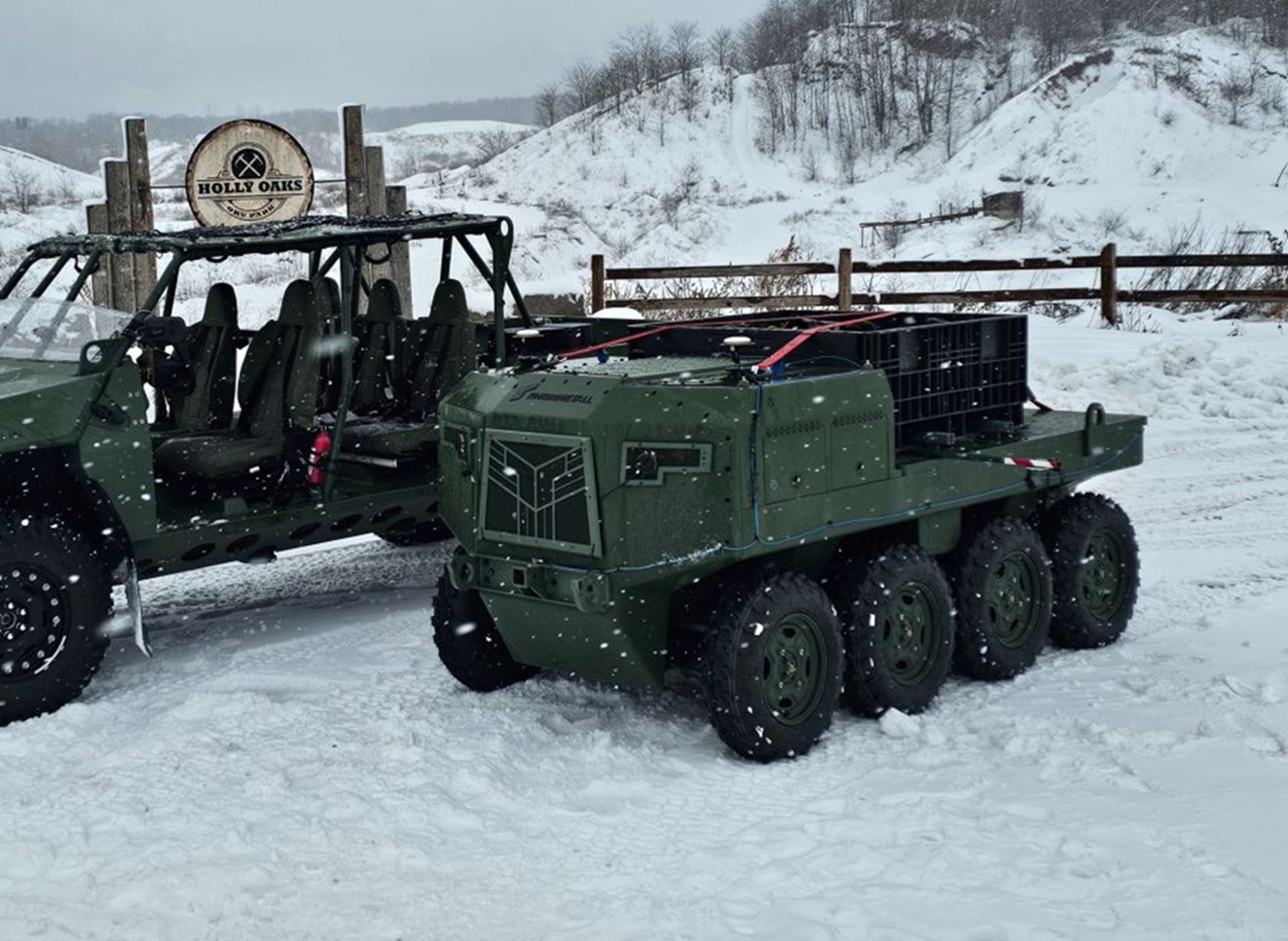
- American Rheinmetall conducted cold-weather and snow testing of its Ox Unmanned Ground Vehicle under the U.S. Army’s GOAT program.
- The company said the tests validated mobility, towing performance, and readiness to integrate multiple mission payloads, including resupply and CASEVAC.
American Rheinmetall has revealed winter testing of its Ox Unmanned Ground Vehicle, showing the platform operating in snow and low-temperature conditions as part of its push to meet U.S. Army requirements for autonomous and semi-autonomous ground transport.
According to a statement published by American Rheinmetall, the tests were conducted under the Army’s Ground Optionally Autonomous Transport, or GOAT, program. The company said the evaluations focused on validating the Ox UGV’s ability to operate reliably in harsh environments before it is fielded to soldiers.
“Before any vehicle reaches the hands of a Soldier, it must prove it can handle the mission,” the company said in its post.
The Ox UGV is described by American Rheinmetall as a modular, mission-ready unmanned ground vehicle designed to enhance the operational effectiveness of dismounted soldiers. The company says the platform is built on more than 20 years of Rheinmetall experience in unmanned ground systems and is aligned with U.S. Army requirements for mobility, silent operation, signature management, and modular payload integration.
As noted by the company, the Ox is designed to support a wide range of missions, including casualty evacuation, resupply, electronic warfare, and counter-unmanned aerial systems. The vehicle is autonomy-ready and uses a modular architecture intended to allow rapid integration of different mission packages depending on operational needs.
During the latest tow test conducted in snowy conditions, American Rheinmetall said the Ox achieved several objectives tied to the GOAT program. According to the company, the testing reduced risk through internal design validation, set conditions for a strong Technical Integration Capability evaluation, and demonstrated what it described as a “go-anywhere” capability.
The company said the vehicle showed it could follow soldiers across difficult terrain in winter conditions, reinforcing its intended role as a logistics and support asset operating close to the tactical edge.
American Rheinmetall also said the tests confirmed the Ox’s readiness to integrate any mission package the Army may require, highlighting the vehicle’s payload flexibility. The UGV is designed to operate with a low acoustic and thermal signature, a factor that is increasingly emphasized in modern ground operations.
“The Ox isn’t just a platform; it’s a dependable wingman prepared for whatever the Army calls it to do,” the company said.
The GOAT program is aimed at evaluating optionally autonomous transport vehicles that can reduce the physical burden on soldiers while improving sustainment in contested or difficult terrain. Systems under consideration are expected to move supplies, equipment, and casualties while keeping troops out of direct exposure to threats.
Cold-weather testing is a key requirement for U.S. Army ground systems, particularly as planners emphasize operations in Arctic and sub-Arctic environments, as well as winter conditions in Europe. Vehicles must demonstrate mobility, reliability, and endurance in snow, ice, and low temperatures, where mechanical failures and reduced battery performance can quickly degrade capability.
American Rheinmetall has been positioning the Ox UGV as a solution that combines proven European unmanned systems experience with U.S. Army operational requirements.