


Serbia has publicly displayed newly acquired Russian electronic warfare systems, including the Krasukha-2, during a recent military parade in Belgrade.
The presentation marked the first public acknowledgment that Serbia had received the systems from Russia, despite ongoing international sanctions tied to Moscow’s full-scale invasion of Ukraine.
According to information released during the parade, Serbia showcased several heavy electronic warfare vehicles from the Krasukha family.
The Krasukha-2, officially designated as 1L269, is a mobile radar jamming complex mounted on an eight-wheeled platform. Russia first delivered these systems to its own armed forces in 2012, with follow-on production by KRET fulfilling a 2014 state defense order later that year.
Technical details of the Krasukha-2 remain classified, but Russian sources claim the system is designed to interfere with modern radar stations, creating active jamming to degrade enemy situational awareness. Estimates place its effective range between 400 and 800 kilometers. The system is considered one of the most powerful of its kind, able to disrupt the operation of airborne radars and surveillance assets.
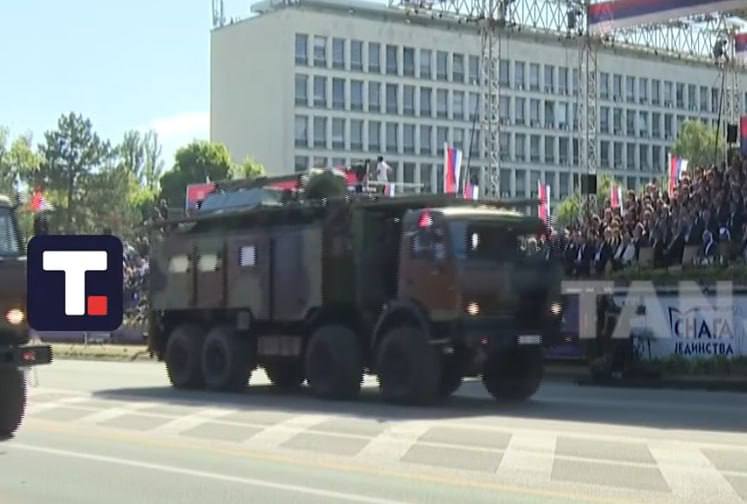
The Krasukha series comprises two main variants: the 1L269 Krasukha-2 and the 1RL257 Krasukha-4. The latter is designed for broader missions, including jamming satellite communication frequencies. Reports indicate the Krasukha-4 can interfere with SATCOM across several frequency bands, including X-band (7.9–8.4 GHz), Ku-band (10.9–14 GHz), and Ka-band (18–40 GHz).
During the Belgrade parade, both Krasukha-2 and Krasukha-4 systems were shown. Serbian authorities presented the platforms as part of a broader display of military equipment, underlining their value for electronic warfare capabilities.
The acquisition highlights Serbia’s continuing defense ties with Russia, even as Moscow faces international isolation and sanctions over its war in Ukraine. Western officials have repeatedly warned against new arms transfers from Russia, but Belgrade’s parade illustrated that deliveries of advanced systems are still occurring.
The Krasukha family of systems is typically employed by independent electronic warfare brigades in the Russian military. Their purpose is to neutralize airborne radars, including those carried by aircraft, drones, and satellites, by generating powerful jamming signals across a wide spectrum of frequencies. These systems are designed to complicate or prevent adversaries from conducting reconnaissance, targeting, or command-and-control operations in contested airspace.
By adding such systems to its inventory, Serbia signals an intent to enhance its own ability to contest electronic domains. While the full scope of integration into Serbian armed forces remains unclear, the public appearance of the Krasukha systems underscores a deepening level of cooperation with Russia in sensitive defense technologies.