


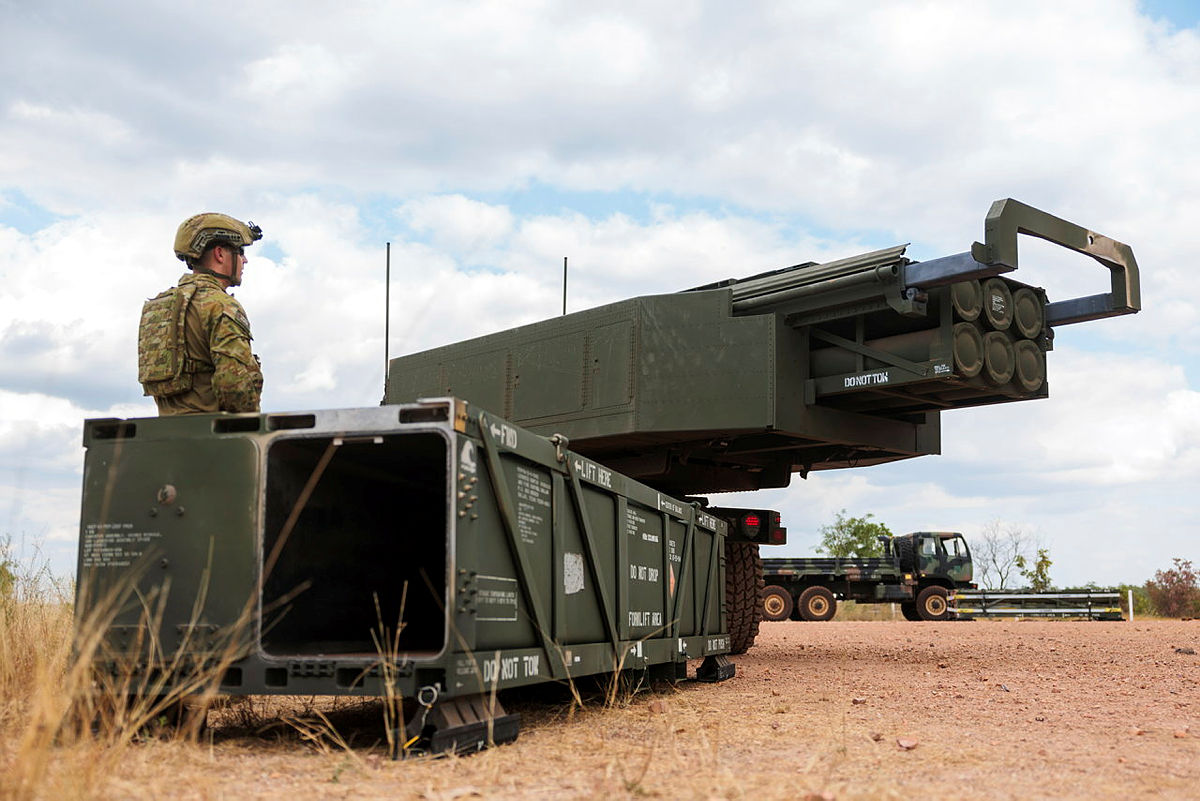
Australia has test-fired its newest long-range missile for the first time, launching the U.S.-made Precision Strike Missile (PrSM) from the Mount Bundey Training Area in the Northern Territory.
The missile traveled more than 300 kilometers in four minutes and three seconds, reaching speeds exceeding 4,000 kilometers per hour before striking its target with high accuracy.
The launch, conducted as part of Exercise Talisman Sabre, showcased the full operational capability of the PrSM in Australian service and marked a major shift in the Army’s ability to project force at extended ranges. Fired from a High Mobility Artillery Rocket System (HIMARS), the weapon expands the Australian Army’s strike envelope from 30 kilometers to up to 500 kilometers.
At a press conference following the launch, Defence Industry Minister Pat Conroy called the event a turning point. “This is all about extending deterrence in the Indo-Pacific, all about signalling to any potential adversary that pain can be inflicted — all about deterring war through strength,” he said.
Developed for the U.S. Army and delivered to Australia last month under a $310 million agreement, the PrSM is designed to deliver rapid, precise strikes against high-value targets. The deal includes access to advanced munitions, future production options, and long-term maintenance support for Australian forces.
Alex Miller, the U.S. Army’s Chief Technology Officer, said the missile’s speed and accuracy reduce response time for adversaries. “When you think about having six to seven minutes rather than 15 to 20 minutes, that’s a lot less time for [a target] to pack up and roll out if they learn that they are being shot at,” he said. While the PrSM is not designed for wide-area destruction, Miller noted that its lethality lies in precision: “It’s not going to level a city, but it will find its target.”
The launch took place during the largest iteration of Talisman Sabre since the exercise began in 2005, involving more than 40,000 troops from 19 nations. It serves as a joint readiness drill focusing on live-fire, air combat, and maritime operations.
The U.S. Army Secretary, Dan Driscoll, spoke plainly about the broader context of the launch. “President Trump, [the United States Secretary of Defence] Pete Hegseth and the rest of the Pentagon team have been very clear that our pacing threat is China,” Driscoll said. “We are actively designing our army so that we are capable of responding to any threat from China.”
General Randy George, Chief of Staff of the U.S. Army, avoided referring to any immediate confrontation but emphasized the urgency of modernization. “What we are trying to do is to transform as rapidly as possible,” he said. “Keeping up with technological advancements is what keeps us up at night.”
Australia’s adoption of the PrSM places it among a growing group of U.S. allies with access to extended-range precision fires. Beyond its tactical value, the missile enhances joint operational flexibility across the Indo-Pacific region, enabling allied forces to cover wider areas with fewer deployed assets.